 Universe Today
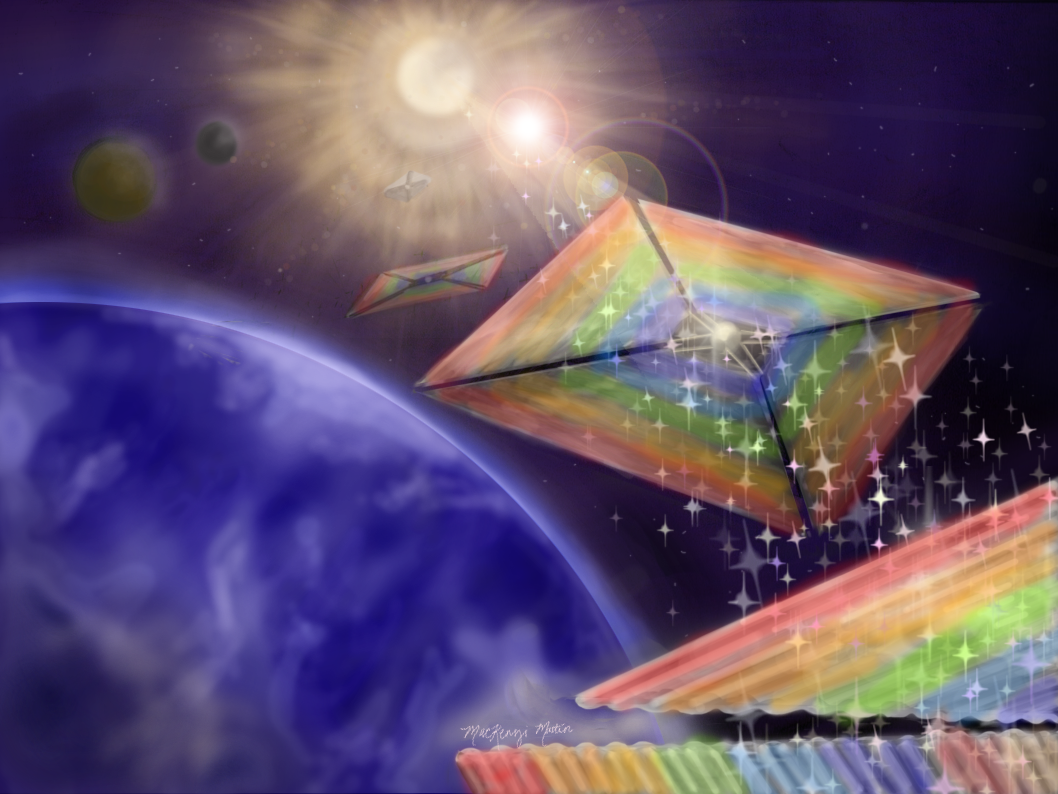
If we’re to reach another star, chemical propulsion will not get us there in any reasonable time frame. We’re going to need a different propulsion technology, and one of the most promising seems to be a solar sail. These giant reflective surfaces form the basis of many interstellar missions. Combined with giant lasers pushing them, they can be accelerated to speeds unreachable by any other current technologies. However, according to a new paper available on arXiv from Chao Shen and Jiaze Li of the Harbin Institute of Technology, once those missions start reaching a significant percentage of the speed of light they’re going to run into a drag force from the light itself.
The paper breaks down the three forces photons hitting a solar sail impart to it. In order of decreasing efficiency they are incident light (that raw momentum of the photons hitting the sail), specular reflection (momentum imparted when photons bounce perfectly off the sail), and diffuse scattering (momentum from photons that are absorbed by the sail then reemitted in random directions).
When the light sail starts to reach relativistic speeds is where the problems start to come in. As it speeds away from its light source it starts to experience a severe Doppler effect. As the frequency of the light drops, the thrust generated by the three components of light rapidly decreases, making it harder and harder to keep accelerating the faster you go.
Many interstellar missions have come and gone - including Breakthrough StarshotIt gets even worse when the light sail hits 75% of the speed of light. At that point, a phenomenon called relativistic light aberration takes over. From the perspective of a stationary observer on Earth, the diffusely scattered light is directed forward towards the sail’s direction of motion. Since every action must have an equal and opposite reaction, that means the diffuse scattering (admittedly the weakest of the three forces) becomes an active drag on the system past 75% of the speed of light.
Admittedly, the net force of the pushing laser remains positive at that point, but the efficiency drop-off is significant. It is worth noting that the paper focuses exclusively on radiative dynamics and does not account for non-radiative factors, such as drag from interstellar gas or dust, nor does it address thermal limitations of sail materials, such as potential melting under high-power lasers. The paper treats the lightsail material as an idealized mirror. In practice, aerospace engineers are exploring advanced metamaterials and photonic crystals tuned to specific laser wavelengths. These materials could potentially leverage the aberration effects discussed in the paper to actively self-correct and stabilize the lightsail’s flight path, ensuring it remains centered in the beam.
Fraser discusses how to determine whether current technology can get us to another star.But we’re still a long way away from actively building and testing a fully fledged interstellar solar sail. When traveling that far there are even more complications, like the curvature of spacetime, which the paper also simplifies out. But every step towards understanding the flight dynamics in such a system is a step in the right direction, because, when we eventually do decide to send a probe to another star, we’ll need all the engineering and understanding we can get.
Learn More:
C. Shen & J. Li - Relativistic Lightsail Propulsion Dynamics
UT - Researchers Create a Nanoengineered Light Sail That Won't Melt
UT - New Lightsail Material Pushes Interstellar Probe Dream Closer
UT - Photonic Lightsails are our Best Shot at Reaching Another Star
